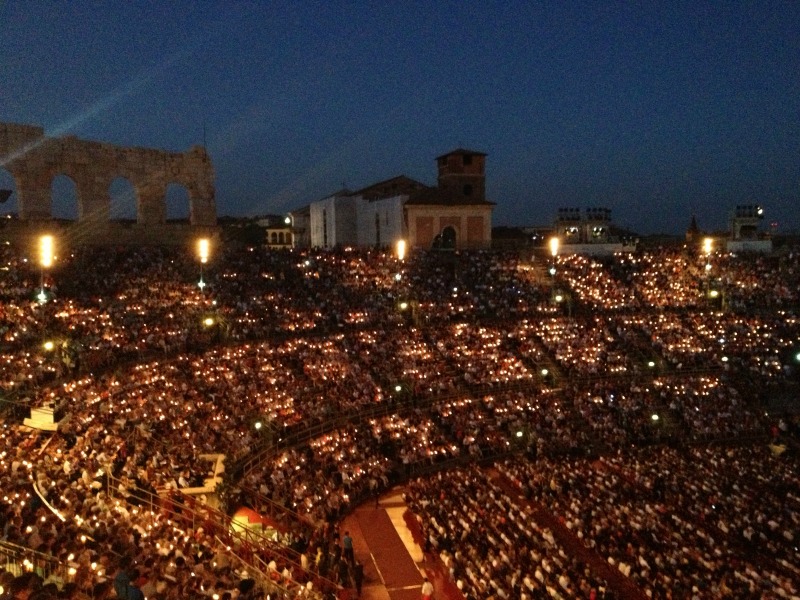
There is no opera experience anywhere quite like the Arena di Verona. Each summer, a Roman amphitheatre built almost two thousand years ago transforms into the largest open-air opera house in the world — a stage so vast it holds full-scale productions of Aida with hundreds of performers, watched by some 13,000 people under the night sky. Seeing opera here, by candlelight, is one of the great experiences in the performing arts.
A Roman amphitheatre turned opera house
The Arena was built around 30 AD, making it older than the Colosseum in Rome and one of the best-preserved Roman amphitheatres in the world. For centuries it hosted gladiatorial games and public spectacles; today its pink-and-white limestone tiers and open elliptical bowl are the setting for one of Italy's most famous cultural events.
The modern opera festival began in 1913, when a monumental production of Verdi's Aida was staged to mark the centenary of the composer's birth. It was an immediate sensation, and the Arena di Verona Opera Festival has run almost every summer since — interrupted only by the two World Wars.
The festival: what's on and when
The festival runs across the summer, roughly from June to early September. The programme is built around the grand Italian repertoire — Aida, Carmen, La Traviata, Tosca, Nabucco and Turandot appear regularly — staged at a scale impossible in a conventional theatre, with enormous sets, casts of hundreds, live horses, and elaborate processions.
Performances begin after dark, typically around 9pm, so the productions are lit dramatically against the night. A treasured tradition survives from the early years: just before the music starts, the audience lights small candles across the stone tiers, and the whole amphitheatre flickers into life.
Find the current programme and book upcoming opera in Verona, along with ballet and classical concerts in Verona, with direct ticket links on PerformingArtsAtlas.
Where to sit: seats and tiers
Seating in the Arena divides into two very different experiences, and choosing well matters more here than at a conventional opera house:
- Numbered seats (poltronissime and poltrone) — padded chairs on the floor of the arena (the platea), closest to the stage. The most comfortable and most expensive option, with the best view of the spectacle.
- Numbered stalls on the lower stone tiers (gradinata numerata) — a middle option with a reserved place and a good elevated view.
- Unnumbered stone steps (gradinata) — the ancient Roman tiers themselves, sold without assigned seats. These are by far the cheapest tickets and the most atmospheric — but they are bare stone, so arrive early to claim a spot and bring or rent a cushion.
For a first visit on a budget, the unnumbered gradinata is an unforgettable way to experience the Arena. If you want comfort and the closest view of the staging, choose the numbered floor seats.
How to get tickets
Tickets are sold through the official festival website (arena.it) and the box office on Via Dietro Anfiteatro, near the amphitheatre. The full summer programme is usually published months ahead, and the most popular nights — especially the marquee Aida performances — sell out early.
- Book in advance for numbered seats and for any performance on a weekend or public holiday.
- Unnumbered stone-tier tickets are often available much closer to the date, including on the day at the box office.
- Prices range from around €25 for the unnumbered gradinata to €200 or more for premium floor seats on a gala night.
- Cushion rental is available at the entrance if you're sitting on the stone steps — well worth it for a three-hour performance.
What to expect from open-air opera
The Arena's natural acoustics are extraordinary: it was designed so that a voice from the centre carries to the highest tiers, and great singers fill the space without strain. The trade-off for performing outdoors is the weather — performances can be delayed or, occasionally, cancelled if there's heavy rain. If a performance is stopped before a certain point, tickets are usually exchanged or refunded; check the festival's conditions when you book.
Evenings can cool down even in high summer, so bring a light layer. And because the productions are staged on a colossal scale, the experience is as much about spectacle and atmosphere as musical detail — this is grand opera at its most theatrical.
Dress code and etiquette
Unlike the formality of La Scala, the Arena is relaxed and informal. There's no dress code — comfortable clothes and flat shoes for the stone steps are sensible. The atmosphere is warm and communal, particularly on the tiers, where the candlelit ritual and the shared anticipation make for a uniquely sociable kind of opera night.
Getting there
The Arena sits in Piazza Bra, the grand central square of Verona, and the city is easy to reach by train on the main Milan–Venice line:
- By train: Verona Porta Nuova is the main station, about a 15-minute walk or a short bus ride from Piazza Bra. Verona is roughly 1h15 from Milan and 1h10 from Venice by fast train.
- On foot: the Arena is in the heart of the old town — most of central Verona is within easy walking distance.
- Address: Piazza Bra, 37121 Verona.
Piazza Bra and the surrounding streets are lined with cafés and restaurants — ideal for an early dinner before a performance that won't end until close to midnight. Use PerformingArtsAtlas to see what's on in Verona during your visit and book directly.